
Define the scope
What problem does this service address?
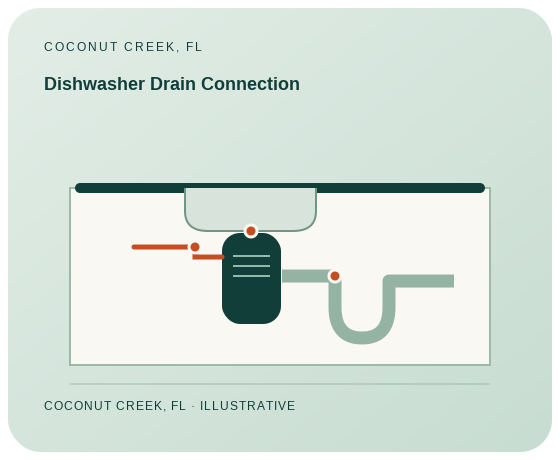
Dishwasher drain connection service checks how the dishwasher’s used water enters the kitchen waste system. When it connects through a garbage disposal, the inlet preparation, hose, fastening and model-specific routing all matter. A disposer can operate and the sink can drain while the dishwasher still has a connection problem. The assessment therefore needs a dishwasher discharge check, not only a brief sink-water test.
Compare the existing symptom with our Coconut Creek disposal replacement guide for dishwasher drain connection before choosing between correction and a new appliance. This guide focuses on connect or correct a dishwasher drain at the disposer inlet; explain what is happening now rather than ordering work from the service name alone.
Diagnosis before parts
How is the right method selected?
We identify the dishwasher and disposal models, traces the hose route and checks the receiving inlet. A new disposal inlet may have a knockout plug that must be prepared according to the manufacturer’s instructions when used for dishwasher discharge. Routing must meet the equipment instructions and applicable requirements. The correct arrangement should be confirmed for the actual installation rather than copied from an unrelated kitchen photograph.
A faucet-only demonstration may miss the fault. Include the receiving inlet and a dishwasher discharge cycle in the agreed check, especially when the trouble began immediately after disposal replacement.
Describe what you see
Which eight clues should you mention?
The timing of a dishwasher pump cycle can distinguish its receiving connection from a sink-side leak or another appliance fault.
- Trouble began after disposal replacement: an inlet preparation or connection issue needs consideration.
- Water remains in the dishwasher: distinguish a waste-connection issue from an internal appliance fault.
- A leak appears during pumping: identify the first wet connection without touching live or moving equipment.
- The hose is compressed by storage: tell us what presses against its visible route.
- The sink backs up during a cycle: the shared waste path may be restricted beyond the hose.
- A hose is visibly damaged: replacement and correct routing may be needed rather than retightening alone.
- A newly unused inlet was connected: confirm that its preparation followed the actual disposal instructions.
- A drain repair changed the cabinet layout: include both appliance connections in the completion test.
Separate the components
What can change the proposed correction?
An unprepared inlet after appliance replacement can prevent discharge. A kinked hose, damaged connection, loose fastening or restriction elsewhere in the waste route can produce different symptoms. A dishwasher that retains water may also have an internal appliance fault. Timing matters: tell us whether trouble began immediately after a disposer change, after cabinet storage moved or independently of any kitchen work.
One alternative to compare is garbage disposal installation. If a new disposer is being added, plan the receiving inlet and the dishwasher route together before assembly. A first installation must account for supply, support and waste connections; it does not automatically include internal dishwasher diagnosis.
Prepare the useful evidence
What can you prepare without taking equipment apart?
Record both model numbers if they are safely accessible, photograph the visible hose route and describe when water backs up or leaks. Stop operating the dishwasher if discharge escapes into the cabinet. Do not remove inlet parts, pull a built-in appliance out or loosen a hose while equipment may operate. Leave model-specific preparation and any uncertain isolation to us.
- The exact model and any safely visible connection information.
- A short timeline of the symptom and the last kitchen work.
- Photographs of the present arrangement rather than dismantled parts.
- The owner or manager who can authorize the proposed correction.
Assessment through handover
What should happen during us visit?
Establish the starting condition.
Ask us to establish whether the fault belongs to the drain connection, common waste route or dishwasher itself. Agree on which equipment it will inspect and whether appliance service would be separate. Following a connection correction, request a suitable drain-cycle test with accessible joints observed. We should explain any inlet preparation, hose replacement or routing change actually included in the completed work.
Agree on the work and its boundaries.
For dishwasher connection work, identify both appliance models and define inlet preparation, hose changes and routing. Ask whether our scope includes only the external waste connection or also internal appliance diagnosis, then agree on a discharge test that exercises the corrected path.
Check the finished arrangement.
Look for a connection that remains dry during the agreed discharge test and a clear explanation of the hose arrangement. Ask us to secure the route so normal cabinet storage does not press against it. Keep the disposer and dishwasher model information with the invoice. If the dishwasher still retains water after the connection is confirmed, discuss a separate appliance diagnosis rather than repeating the same fitting change.
Compare the complete scope
What affects cost and approval requirements?
The proposal can depend on hose condition, accessibility, inlet preparation, required fittings and whether the existing route is usable. Work on the dishwasher’s internal pump or controls is a different scope from correcting its waste connection. Ask for that boundary in writing. If a new disposer is being fitted at the same time, make sure connection preparation and the final dishwasher test are included explicitly.
| Equipment identification | Correct dishwasher and disposal models and their connection requirements. |
|---|---|
| Hose and inlet | Preparation, condition, fittings and accessible fastening points. |
| Route correction | Clearance and any changes needed to achieve the proper arrangement. |
| Scope boundary | Connection testing versus separate internal dishwasher diagnosis. |
Have us confirm project-specific plumbing and electrical permit requirements with Coconut Creek’s Building Division. An owner’s or association’s permission is separate. A master association, sub-community and individual owner can have different roles. Ask which party needs to approve the actual plumbing or electrical scope. That discussion is separate from Coconut Creek’s determination of municipal permit requirements and from our assessment of mechanical fit.
Address the active fault
When should normal use stop?
Stop a dishwasher that is sending water into the cabinet or backing up through a sink. Do not repeatedly run a cycle to demonstrate a known overflow. Keep clear of wet electrical equipment and notify property management if water may affect another home or a common area. An active leak needs containment and assessment before another full discharge test is attempted.
Plan for the actual home
How does the property setting affect the visit?
Local context for Regency Lakes: Regency Lakes contains multiple sub-communities under a master association. Identify the sub-community and actual home type when arranging disposal work. That is a practical way to settle access and approval questions before comparing the appliance, dishwasher connection or the available cabinet space.
Ask for current contractor-entry instructions for the relevant sub-community. A broad gated-community description does not supply today’s entry process, required resident contact or work authorization. Give us the confirmed details once the proposed visit and its charges are understood.
A different setting is Victoria Isles. Housing examples around 2000–2001 do not establish that a sink or unit is original. Show the current bowl depth, adjacent cabinet panels and dishwasher hose. A larger sound-treated appliance needs a clearance comparison just as much as a basic replacement. Discuss these details when requesting dishwasher drain connection so the proposal fits the home rather than a broad neighborhood assumption.
Six practical answers
What should you ask before authorizing the work?
Can a new disposal block dishwasher discharge? Start with that distinction, then confirm the business’s own proposal and terms.
Can a new disposal block dishwasher discharge?
Where the dishwasher uses the disposal inlet, a factory closure must be prepared according to the selected model’s instructions. An unprepared inlet is one possibility after replacement, but we should also check hose routing and the connected waste path.
Is retained dishwasher water always a plumbing problem?
No. The hose, receiving connection and waste route are possible causes, while the dishwasher can also have its own fault. Ask which scope we can diagnose and whether a separate appliance technician would be required for internal work.
Should the hose routing match my old installation?
The correct reference is the current equipment instructions and applicable requirements. An existing route is not proof of suitability. Have us verify the proposed connection rather than preserving an unsuitable arrangement simply because it was already there.
Can storage under the sink affect the connection?
Objects can press against an exposed hose or obstruct access. Photograph the normal cabinet arrangement and ask us to explain what clearance should remain. Do not pull or reposition fixed connections as a way to create storage space.
What should be tested after the work?
A relevant dishwasher drain cycle should be checked along with the receiving sink route and accessible joints. A sink faucet test alone does not exercise every part of the dishwasher discharge arrangement. Ask what the final check actually included.
What if the disposal will be removed?
The dishwasher still needs a suitable waste connection after a drain conversion. Include that route in the removal proposal before the old appliance is disconnected. Confirm who supplies the fitting and how the completed dishwasher discharge will be tested.
Coconut Creek communities
Where can you find this service by community?
In the dishwasher drain connection guide for Regency Lakes, the local starting question is: Which sub-community instructions apply to this visit and this particular work scope? Confirm the actual address and coverage directly with us.
- Dishwasher Drain Connection in Township
- Dishwasher Drain Connection in Wynmoor
- Dishwasher Drain Connection in Winston Park
- Dishwasher Drain Connection in South Creek
- Dishwasher Drain Connection in Regency Lakes
- Dishwasher Drain Connection in Centura Parc
- Dishwasher Drain Connection in Country Lakes
- Dishwasher Drain Connection in Tallowwood Isle
- Dishwasher Drain Connection in Banyan Trails
- Dishwasher Drain Connection in CocoBay
- Dishwasher Drain Connection in Victoria Isles
- Dishwasher Drain Connection in Coquina
- Dishwasher Drain Connection in Buttonwood Hammocks
- Dishwasher Drain Connection in Indigo Lakes
- Dishwasher Drain Connection in Crescent Creek