
Define the scope
What problem does this service address?
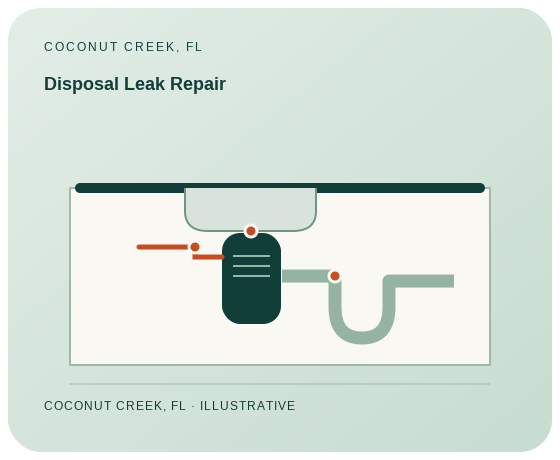
Garbage disposal leak repair addresses the connection or component that is releasing water. Water at the bottom of a disposer does not prove that the bottom is the source: it can travel down from the sink mount, dishwasher inlet or discharge connection. A useful inspection follows the wet path upward and relates it to the activity that caused the leak. That distinction determines whether a connection correction or another appliance is appropriate.
Compare the existing symptom with our Coconut Creek disposal replacement guide for garbage disposal leak repair before choosing between correction and a new appliance. This guide focuses on locate and correct the source of water around the disposer; explain what is happening now rather than ordering work from the service name alone.
Diagnosis before parts
How is the right method selected?
We separate sink-side, discharge-side and dishwasher-related observations. A leak while water stands in the bowl suggests a different test from a leak only when the dishwasher pumps out. Accessible connections are examined with the equipment safe to approach, and the suspected source is checked after correction. Changing several fittings without locating the source can hide the reason for failure and complicate later troubleshooting.
Use the operating condition as part of the source test. A dishwasher-only leak calls for a different observation from water appearing under a filled bowl. Ask which source the proposed component actually corrects.
Describe what you see
Which eight clues should you mention?
Record where moisture starts and which activity triggers it; the final drip location can differ from the source.
- A wet sink collar: the connection beneath the bowl may deserve investigation before the housing is blamed.
- Drips during dishwasher discharge: report the timing so the inlet and hose can be checked separately.
- Water at the discharge elbow: the gasket, fittings and alignment need assessment together.
- A trail down the enclosure: locate the highest wet point; gravity can mislead a quick visual check.
- Moisture after standing water: tell us whether a filled bowl triggers the symptom.
- Fresh stains in the cabinet: record their location, while recognizing stains can remain after an older leak.
- Movement at the mount: do not attempt to support a heavy unit by tightening random components.
- Leakage after recent replacement: retain our details and describe which test first revealed the problem.
Separate the components
What can change the proposed correction?
A disturbed mounting seal, damaged discharge gasket, unsuitable hose connection or cracked component can each release water. Stress from misaligned pipework may also affect a joint. Cabinet staining records that water has been present, but not necessarily where the current leak begins. If the body is genuinely leaking after upper connections are excluded, the proposal may shift from sealing an external joint to replacing the appliance.
One alternative to compare is garbage disposal flange replacement. A confirmed sink-side source can make mounting work relevant, but a discharge gasket or dishwasher hose is a different connection. Have us show why the selected repair corresponds to the first wet point rather than the place where drips collect.
Prepare the useful evidence
What can you prepare without taking equipment apart?
Stop the activity that produces leakage and move stored items only when the cabinet is safe to approach. Photograph the first wet point you can see without touching wiring or supporting the appliance. Note whether the sink was filled, the motor was running or the dishwasher was draining. Do not smear sealant over a suspected body crack or loosen the mount to look for the source.
- The exact model and any safely visible connection information.
- A short timeline of the symptom and the last kitchen work.
- Photographs of the present arrangement rather than dismantled parts.
- The owner or manager who can authorize the proposed correction.
Assessment through handover
What should happen during us visit?
Establish the starting condition.
Ask us to identify the source before quoting a specific seal or replacement. The assessment should consider the sink mount, discharge elbow, dishwasher inlet and any pipe connection carrying stress. Agree on whether cabinet damage or another plumbing fault belongs in the same proposal. After the correction, the relevant water-use condition needs to be repeated safely so the original symptom is meaningfully checked.
Agree on the work and its boundaries.
For leak tracing, agree on the suspected connection and the test used to verify it. Ask whether any cabinet damage belongs to another scope and whether replacement would be proposed only after we distinguishes a true housing leak from water traveling down its exterior.
Check the finished arrangement.
Have us show the repaired area during testing rather than simply wiping the cabinet dry. Ask whether a sink fill-and-drain check and any connected dishwasher discharge were both evaluated. Keep an eye on the accessible cabinet afterward and report fresh moisture promptly. Cosmetic drying is different from confirming that the source has stopped, and cabinet restoration may require a separate service.
Compare the complete scope
What affects cost and approval requirements?
Leak-location work, the failed component, condition of mounting hardware and access to the joint affect cost. Replacing a discharge gasket is a different scope from removing a damaged mount or exchanging a leaking housing. Ask which tests support the proposed remedy, which parts are included and whether hidden cabinet damage is excluded. No single advertised appliance price describes all of those possibilities.
| Source tracing | Separate mount, discharge, dishwasher and true housing leakage. |
|---|---|
| Failed connection | Compatible seals, hardware or hose parts and the condition of mating surfaces. |
| Removal access | Support, cabinet clearance and any stressed adjacent pipework. |
| Water effects | Define whether drying or cabinet restoration requires separate work. |
Have us confirm project-specific plumbing and electrical permit requirements with Coconut Creek’s Building Division. An owner’s or association’s permission is separate. Define the unit-level plumbing task before anyone works on a suspected common drain. We need to explain whether we are diagnosing the appliance, correcting an accessible connection or recommending a building-level investigation. Association documents and the fault location determine responsibility; the work scope needs to be confirmed for the actual unit.
Address the active fault
When should normal use stop?
An active leak near the electrical connection, water spreading beyond the cabinet or water entering another unit deserves prompt attention. Stop the sink or dishwasher activity responsible and stay away from wet electrical equipment. Notify building management where shared or neighboring property may be affected. Do not leave a faulty appliance operating over a collection bowl as a substitute for assessment; the next discharge can exceed the container.
Plan for the actual home
How does the property setting affect the visit?
Local context for Wynmoor: Wynmoor is a condominium community with independent associations, so the exact building matters more than the broad campus name. Give the building, floor and unit when describing a disposal project. That allows the conversation to address work authorization, arrival and the possibility that water from one kitchen could affect another home.
Confirm current trade-entry instructions with the appropriate association or manager before arranging a visit. Council-level information and the authority for an individual building are not interchangeable. Ask where we should arrive and which resident or owner will give access to the kitchen.
A different setting is Tallowwood Isle. The sink and cabinet need to be assessed as components of the actual manufactured home. A batch-feed stopper routine and a lower-noise model can be compared only after dimensions, mounting compatibility and electrical provision are known. Comfort preferences should not bypass feasibility checks. Discuss these details when requesting garbage disposal leak repair so the proposal fits the home rather than a broad neighborhood assumption.
Six practical answers
What should you ask before authorizing the work?
Does a drip underneath mean the housing is cracked? Start with that distinction, then confirm the business’s own proposal and terms.
Does a drip underneath mean the housing is cracked?
Not necessarily. Water can run from a higher mounting or hose connection and collect at the base. Ask us to distinguish a true body leak from water tracking down its exterior before recommending a replacement.
Can the mounting seal be repaired separately?
A sink-side leak may be correctable through the appropriate mounting work if the sink and supporting parts are suitable. We need to establish the condition and compatible assembly. It is different from trying to seal an internally failed disposer body.
Why does it leak only when the dishwasher runs?
That timing makes the dishwasher hose, inlet and discharge route important inspection points. It does not prove which fitting is defective. Describe when pumping occurs and ask for a connected dishwasher test following the proposed correction.
Should cabinet damage be included?
Ask for it to be addressed explicitly. Stopping the plumbing leak, drying affected materials and repairing damaged cabinetry can involve different work. We should explain the boundaries of our proposal instead of leaving restoration assumed.
Can I continue using the other sink bowl?
Do not assume the second bowl has an independent safe route. Both bowls may connect to the affected waste arrangement. Stop the activity that causes leakage and have us determine what can be used while the fault is unresolved.
What demonstrates a completed leak repair?
The suspected source should remain dry under the relevant operating condition, with accessible connections observed. A sink test alone may not test a dishwasher-only leak. Ask what was checked and keep our invoice for any recurrence.
Coconut Creek communities
Where can you find this service by community?
In the garbage disposal leak repair guide for Wynmoor, the local starting question is: Is the proposed work confined to my unit, and who handles a common-line finding? Confirm the actual address and coverage directly with us.
- Garbage Disposal Leak Repair in Township
- Garbage Disposal Leak Repair in Wynmoor
- Garbage Disposal Leak Repair in Winston Park
- Garbage Disposal Leak Repair in South Creek
- Garbage Disposal Leak Repair in Regency Lakes
- Garbage Disposal Leak Repair in Centura Parc
- Garbage Disposal Leak Repair in Country Lakes
- Garbage Disposal Leak Repair in Tallowwood Isle
- Garbage Disposal Leak Repair in Banyan Trails
- Garbage Disposal Leak Repair in CocoBay
- Garbage Disposal Leak Repair in Victoria Isles
- Garbage Disposal Leak Repair in Coquina
- Garbage Disposal Leak Repair in Buttonwood Hammocks
- Garbage Disposal Leak Repair in Indigo Lakes
- Garbage Disposal Leak Repair in Crescent Creek