
The community and the equipment
Why does this service need a property-specific plan?
Township brings several kitchen settings under one community name: a villa, condominium, townhouse and detached home need not share the same work responsibility. Identify the village and dwelling type before describing a disposal problem. As a planning example, consider a Township condo owner distinguishing private sink fittings from a suspected building-managed line.
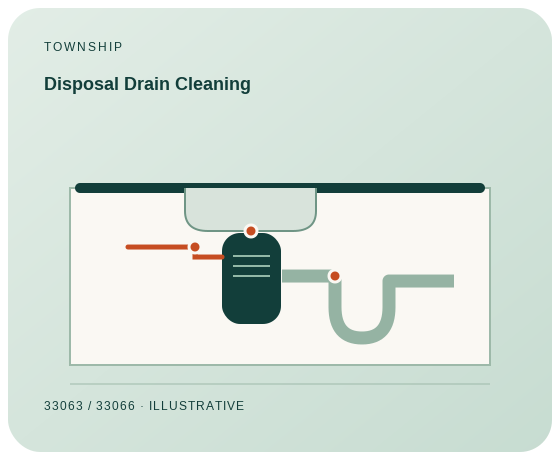
Garbage disposal drain cleaning addresses a restriction in the connected sink waste path. The problem can involve the discharge elbow, trap or kitchen branch rather than the grinding mechanism itself. A kitchen in a largely 1980s master-planned development may have been remodeled several times. Treat the current sink depth, cabinet insert and appliance label as the evidence for fit.
The key distinction is whether the motor works normally while water fails to drain. A useful assessment locates the restriction before choosing an access point or deciding that appliance replacement belongs in the proposal. For this Township project, village identification and the division between kitchen equipment and building-managed drainage shape what information we need before agreeing on the work.
Describe the symptom precisely
Which observations help define the right scope?
For garbage disposal drain cleaning in Township, distinguish the following clues from a confirmed diagnosis. The planned correction needs to match the observed condition, not a community-wide assumption.
Food residue, grease and material that should not enter the sink can collect in the waste path. An unfavorable connection arrangement or another pipe problem can also contribute to recurring slow flow. A kitchen in a largely 1980s master-planned development may have been remodeled several times. Treat the current sink depth, cabinet insert and appliance label as the evidence for fit.
- The motor sounds normal but the bowl stays full: drainage and rotation need separate evaluation.
- Both sink bowls back up: describe the connected behavior rather than reporting only the disposer side.
- Backup appears during dishwasher pumping: the shared waste route and hose connection deserve inspection.
- Slow flow returns soon after cleaning: a recurring restriction or arrangement problem may remain.
Clearing material may restore drainage without correcting an underlying installation issue. When the same sink repeatedly backs up, ask whether we have identified a persistent physical cause rather than assuming another cleaning attempt will permanently resolve it. The same community label should not cause an installer to assume either a shared pipe or complete owner responsibility.
Follow the actual connections
How should the method fit this home?
We compare flow from the affected bowl, the other bowl and any connected dishwasher. The timing of backup helps define the route to inspect. The development period does not date the disposal now fitted beneath a particular bowl.
Accessible waste fittings may need evaluation, while a farther restriction can call for a different cleaning method and access. The method must suit the pipe condition and the location found; a cable, dismantling a fitting and appliance work are not interchangeable solutions. For a condominium or attached unit, establish who can approve changes and who investigates any common drainage. For a detached address, describe that different setting to us.
Safe preparation and access
What should be ready before the visit?
Stop using the sink when water backs up and avoid running the dishwasher into the same restricted route. Tell us about any drain chemical already added, including the product and approximate timing. Use the actual village name as well as Township when arranging arrival. The master association and individual village or building management are different contacts.
Keep others away from standing water containing chemicals. Do not mix products, disconnect a full trap or keep operating the disposer in the hope that motor power will push a downstream obstruction away. Ask the relevant party about present contractor access rather than assuming a single gate procedure covers the entire master plan.
Define the authorized work
What should we explain step by step?
Expect us to establish which fixtures are affected and whether the restriction is local to the sink or part of a broader drainage issue. Ask what access and method are proposed, what the quoted attempt covers and when further authorization would be needed. For Township, ask: Which village or building contact must authorize work beyond this kitchen?
In a managed building, a suspected common-line problem may require coordination before work extends beyond the unit’s assigned responsibility. Record the village and unit on the service paperwork and ask for the actual sink and dishwasher routes to be tested.
Compare a complete proposal
What affects the cost and approval scope here?
Restriction location, available access, pipe condition and the method needed influence cost. Removing an accessible trap obstruction is different from work farther along a kitchen branch or a building-managed route. For a condominium or attached unit, establish who can approve changes and who investigates any common drainage. For a detached address, describe that different setting to us. Relate those responsibilities to the specific garbage disposal drain cleaning proposal rather than treating every kitchen task as identical.
| Community / city | Township, Coconut Creek, FL |
|---|---|
| County | Broward County |
| ZIP context | 33063 / 33066; confirm the particular address |
| Water service | City of Coconut Creek retail water service; Broward County bulk supply. Confirm account/building meter. |
| Plumbing permits | City of Coconut Creek Building Division; confirm the project scope |
| Housing | Villas, condominiums, townhomes and detached homes in multiple villages. |
| Arrival / authority | TCMA master association plus village/building management; gate arrangements vary. |
Ask whether repeated attempts, restoration of removed fittings and testing are included. Where us suspects a connection defect, obtain a clear explanation of why cleaning alone may not be the complete remedy. The development period does not date the disposal now fitted beneath a particular bowl. These are questions for the current Township arrangement, not evidence that the appliances share the community’s construction age.
Verify the original concern
What should you check after the work?
A completion check should use the relevant sink bowls and, where appropriate, the dishwasher discharge. Ask whether normal flow was restored and whether the arrangement showed another defect. If we identify a restriction outside our agreed kitchen scope, obtain a clear account of the finding to pass to the responsible manager.
Keep a record of the access point, cleaning performed and any recommendation for further investigation. A briefly empty bowl does not by itself show that a recurring branch problem has been permanently corrected. A kitchen in a largely 1980s master-planned development may have been remodeled several times. Treat the current sink depth, cabinet insert and appliance label as the evidence for fit. Keep that distinction in the Township service record so the installed model and observed condition remain clear.
Address an active hazard
When should you stop and seek help?
Stop adding water when the bowl is rising or wastewater is escaping into the cabinet. If other fixtures or neighboring units are affected, describe that pattern and alert the relevant building management. For a condominium or attached unit, establish who can approve changes and who investigates any common drainage. For a detached address, describe that different setting to us.
Avoid contact with contaminated water and any wet electrical connection. A backup with a burning or electrical symptom needs those hazards addressed as well; it should not be treated as a routine invitation to keep testing the disposer. Record the village and unit on the service paperwork and ask for the actual sink and dishwasher routes to be tested.
Four local answers
What questions apply to this community and service?
For garbage disposal drain cleaning in Township, use these questions with our project-specific assessment.
What does Township preparation mean for this service?
Use the actual village name as well as Township when arranging arrival. The master association and individual village or building management are different contacts. For garbage disposal drain cleaning, stop using the sink when water backs up and avoid running the dishwasher into the same restricted route. Tell us about any drain chemical already added, including the product and approximate timing.
What should we assess inside this Township kitchen?
We compare flow from the affected bowl, the other bowl and any connected dishwasher. The timing of backup helps define the route to inspect. In this community, a kitchen in a largely 1980s master-planned development may have been remodeled several times. Treat the current sink depth, cabinet insert and appliance label as the evidence for fit.
Who confirms the scope of garbage disposal drain cleaning in Township?
For a condominium or attached unit, establish who can approve changes and who investigates any common drainage. Restriction location, available access, pipe condition and the method needed influence cost. Removing an accessible trap obstruction is different from work farther along a kitchen branch or a building-managed route. For this Township project, have us confirm municipal requirements separately from the owner or community authorization.
Which completion record matters for Township?
Keep a record of the access point, cleaning performed and any recommendation for further investigation. A briefly empty bowl does not by itself show that a recurring branch problem has been permanently corrected. For the Township address, if we identify a restriction outside our agreed kitchen scope, obtain a clear account of the finding to pass to the responsible manager.
Keep the decisions connected
Which related guides help compare the next step?
Compare garbage disposal drain cleaning across Coconut Creek with Township replacement planning. The first guide explains the technical scope, while the second covers the broader household decision for this community. If the existing appliance has failed, replacement planning beyond garbage disposal drain cleaning in Township provides the citywide replacement comparison.
A related scope is garbage disposal unjamming in Township; another is dishwasher drain connection in Township. A mechanical stall belongs to a different part of the system than a restricted pipe. If the motor turns normally, restoring movement cannot by itself establish that the branch is clear. Request a proposal tied to the observed drainage route. Apply the distinction to a Township condo owner distinguishing private sink fittings from a suspected building-managed line rather than authorizing both labels without an explanation.