
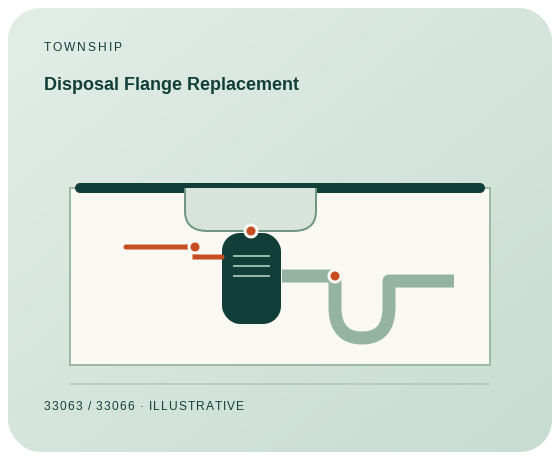
The community and the equipment
Why does this service need a property-specific plan?
Township brings several kitchen settings under one community name: a villa, condominium, townhouse and detached home need not share the same work responsibility. Identify the village and dwelling type before describing a disposal problem. As a planning example, consider a Township owner checking sink-side support while identifying the village’s work-authorization contact.
Garbage disposal flange replacement concerns the sink opening and the mounting assembly that supports the appliance beneath it. It is not the same as replacing the motor. A kitchen in a largely 1980s master-planned development may have been remodeled several times. Treat the current sink depth, cabinet insert and appliance label as the evidence for fit.
A sink-side leak, damaged assembly or incompatibility with a proposed unit can make mounting work part of the project. The sink material, opening, supporting hardware and selected disposal must be considered together before a new flange is ordered. For this Township project, village identification and the division between kitchen equipment and building-managed drainage shape what information we need before agreeing on the work.
Describe the symptom precisely
Which observations help define the right scope?
For garbage disposal flange replacement in Township, distinguish the following clues from a confirmed diagnosis. The planned correction needs to match the observed condition, not a community-wide assumption.
A disturbed seal, unsuitable materials, damaged hardware or movement at the sink connection may create a need for mounting work. Water traveling from another joint can imitate a flange leak, so source tracing comes first. A kitchen in a largely 1980s master-planned development may have been remodeled several times. Treat the current sink depth, cabinet insert and appliance label as the evidence for fit.
- Moisture begins beneath the sink collar: source tracing can distinguish a mounting leak from water tracking elsewhere.
- The appliance moves at the sink: we should assess support before normal use continues.
- Hardware is damaged or heavily deteriorated: compatibility and replacement scope need investigation.
- A different disposer is planned: confirm the mount rather than assuming every brand shares it.
A redesigned sink or replacement appliance may also need different compatible components. Avoid treating every leak or fit problem as evidence that the entire disposer is beyond repair. The same community label should not cause an installer to assume either a shared pipe or complete owner responsibility.
Follow the actual connections
How should the method fit this home?
We check the bowl and existing assembly, identifies compatible mounting parts and plans how the disposal will be supported during removal. The sealing method must suit the sink and product instructions. The development period does not date the disposal now fitted beneath a particular bowl.
Once assembled, the mount is checked for secure engagement and the connected pipework is assessed for unwanted stress. The purpose is a sound supported connection, not simply a new visible ring at the top of the sink. For a condominium or attached unit, establish who can approve changes and who investigates any common drainage. For a detached address, describe that different setting to us.
Safe preparation and access
What should be ready before the visit?
Record the sink material and the disposal model if known, and photograph the upper collar and safely accessible underside. Tell us whether water appears when the bowl holds water, drains or the motor operates. Use the actual village name as well as Township when arranging arrival. The master association and individual village or building management are different contacts.
Do not loosen a supporting ring or attempt to hold the unit while another person releases it. Its weight and connected pipes make that a coordinated equipment-handling task. Ask the relevant party about present contractor access rather than assuming a single gate procedure covers the entire master plan.
Define the authorized work
What should we explain step by step?
Ask us to explain whether we are renewing a seal, replacing a complete assembly or adapting for another model. The proposal should identify compatible parts and any damaged sink surface that affects the result. For Township, ask: Which village or building contact must authorize work beyond this kitchen?
Before reconnection, we need to consider discharge alignment and dishwasher access as well as the mounting point. The final scope should include checking stability, drainage and accessible joints. Record the village and unit on the service paperwork and ask for the actual sink and dishwasher routes to be tested.
Compare a complete proposal
What affects the cost and approval scope here?
Access, compatibility, sink condition and the extent of supporting hardware replacement affect the work. A seal renewal on sound components differs from replacing a damaged assembly or accommodating a changed sink. For a condominium or attached unit, establish who can approve changes and who investigates any common drainage. For a detached address, describe that different setting to us. Relate those responsibilities to the specific garbage disposal flange replacement proposal rather than treating every kitchen task as identical.
| Community / city | Township, Coconut Creek, FL |
|---|---|
| County | Broward County |
| ZIP context | 33063 / 33066; confirm the particular address |
| Water service | City of Coconut Creek retail water service; Broward County bulk supply. Confirm account/building meter. |
| Plumbing permits | City of Coconut Creek Building Division; confirm the project scope |
| Housing | Villas, condominiums, townhomes and detached homes in multiple villages. |
| Arrival / authority | TCMA master association plus village/building management; gate arrangements vary. |
Ask whether appliance removal, reinstallation, drain reconnection and final testing are included. If a sink defect is discovered, obtain an explanation before assuming a new mounting kit alone will correct it. The development period does not date the disposal now fitted beneath a particular bowl. These are questions for the current Township arrangement, not evidence that the appliances share the community’s construction age.
Verify the original concern
What should you check after the work?
Have us demonstrate the sink-side leak check and explain which hardware was replaced. The appliance should be supported by the correct mounting system without depending on the drain pipe for support. If we identify a restriction outside our agreed kitchen scope, obtain a clear account of the finding to pass to the responsible manager.
Ask whether any mark or damage at the bowl was observed and whether it changes care instructions. Keep the part and model information with the invoice for a future appliance exchange. A kitchen in a largely 1980s master-planned development may have been remodeled several times. Treat the current sink depth, cabinet insert and appliance label as the evidence for fit. Keep that distinction in the Township service record so the installed model and observed condition remain clear.
Address an active hazard
When should you stop and seek help?
Stop using a sink or appliance when the mount is visibly unstable or an active leak reaches the cabinet’s electrical components. Do not attempt a quick tightening while the appliance is operating or its support is uncertain. For a condominium or attached unit, establish who can approve changes and who investigates any common drainage. For a detached address, describe that different setting to us.
Arrange an assessment and keep the cabinet clear of unnecessary contact. If water affects another unit, notify the responsible building management while the source is being addressed. Record the village and unit on the service paperwork and ask for the actual sink and dishwasher routes to be tested.
Four local answers
What questions apply to this community and service?
For garbage disposal flange replacement in Township, use these questions with our project-specific assessment.
What does Township preparation mean for this service?
Use the actual village name as well as Township when arranging arrival. The master association and individual village or building management are different contacts. For garbage disposal flange replacement, record the sink material and the disposal model if known, and photograph the upper collar and safely accessible underside. Tell us whether water appears when the bowl holds water, drains or the motor operates.
What should we assess inside this Township kitchen?
We check the bowl and existing assembly, identifies compatible mounting parts and plans how the disposal will be supported during removal. The sealing method must suit the sink and product instructions. In this community, a kitchen in a largely 1980s master-planned development may have been remodeled several times. Treat the current sink depth, cabinet insert and appliance label as the evidence for fit.
Who confirms the scope of garbage disposal flange replacement in Township?
For a condominium or attached unit, establish who can approve changes and who investigates any common drainage. Access, compatibility, sink condition and the extent of supporting hardware replacement affect the work. A seal renewal on sound components differs from replacing a damaged assembly or accommodating a changed sink. For this Township project, have us confirm municipal requirements separately from the owner or community authorization.
Which completion record matters for Township?
Ask whether any mark or damage at the bowl was observed and whether it changes care instructions. Keep the part and model information with the invoice for a future appliance exchange. For the Township address, if we identify a restriction outside our agreed kitchen scope, obtain a clear account of the finding to pass to the responsible manager.
Keep the decisions connected
Which related guides help compare the next step?
Compare garbage disposal flange replacement across Coconut Creek with Township replacement planning. The first guide explains the technical scope, while the second covers the broader household decision for this community. If the existing appliance has failed, replacement planning beyond garbage disposal flange replacement in Township provides the citywide replacement comparison.
A related scope is garbage disposal leak repair in Township; another is garbage disposal installation in Township. Water at a collar may need mounting work, but a leak-tracing assessment can establish whether an upper connection is genuinely the source. We should explain which surface or component failed before treating every wet housing as a flange problem. Apply the distinction to a Township owner checking sink-side support while identifying the village’s work-authorization contact rather than authorizing both labels without an explanation.