
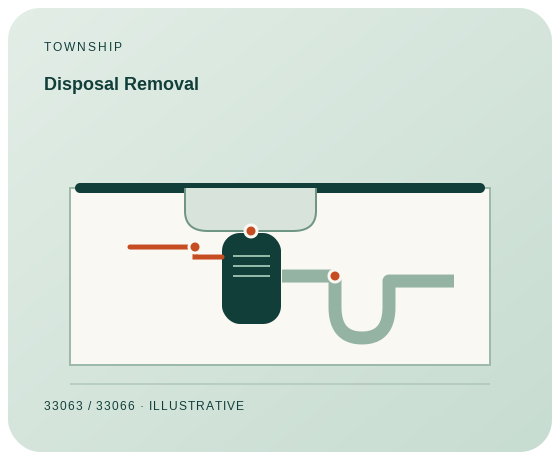
The community and the equipment
Why does this service need a property-specific plan?
Township brings several kitchen settings under one community name: a villa, condominium, townhouse and detached home need not share the same work responsibility. Identify the village and dwelling type before describing a disposal problem. As a planning example, consider a Township resident seeking a conventional drain while confirming who may approve the kitchen change.
Garbage disposal removal converts the sink from a powered disposer to a suitable conventional waste connection. Taking out the motor is only part of the work. A kitchen in a largely 1980s master-planned development may have been remodeled several times. Treat the current sink depth, cabinet insert and appliance label as the evidence for fit.
The sink needs a compatible strainer, a complete discharge and trap arrangement, and an appropriate route for any dishwasher that previously drained through the unit. Electrical disconnection or termination must also be assigned to the appropriate qualified trade. For this Township project, village identification and the division between kitchen equipment and building-managed drainage shape what information we need before agreeing on the work.
Describe the symptom precisely
Which observations help define the right scope?
For garbage disposal removal in Township, distinguish the following clues from a confirmed diagnosis. The planned correction needs to match the observed condition, not a community-wide assumption.
Removal may be a household preference, an alternative after appliance failure or part of a cabinet and sink redesign. Those reasons do not establish that the existing branch drain is clear or that every old fitting can be reused. A kitchen in a largely 1980s master-planned development may have been remodeled several times. Treat the current sink depth, cabinet insert and appliance label as the evidence for fit.
- You prefer a conventional sink: explain the intended final use so we can plan the complete conversion.
- The old housing leaks: the active fault and any wet electrical area need attention before handling.
- A dishwasher uses the disposal inlet: its replacement discharge connection must be included.
- Storage is the main goal: compare the shape of the proposed trap and fittings before expecting a clear cabinet.
A leaking mount or damaged pipe may require correction during conversion. Ask us to evaluate the intended finished arrangement instead of quoting only the time needed to detach the old unit. The same community label should not cause an installer to assume either a shared pipe or complete owner responsibility.
Follow the actual connections
How should the method fit this home?
We assess the sink opening, existing drain and dishwasher hose before selecting replacement fittings. It plans safe support of the appliance while removing it and checks that the proposed conventional drain can connect without unsuitable alignment. The development period does not date the disposal now fitted beneath a particular bowl.
Any electrical work is handled within the confirmed trade scope. The finished sink must drain correctly and the dishwasher must retain a functioning discharge route rather than a loose hose left behind. For a condominium or attached unit, establish who can approve changes and who investigates any common drainage. For a detached address, describe that different setting to us.
Safe preparation and access
What should be ready before the visit?
Decide whether you want a conventional sink permanently or are comparing removal with another disposal. Photograph the visible dishwasher hose, drain route and cabinet obstructions. Use the actual village name as well as Township when arranging arrival. The master association and individual village or building management are different contacts.
Tell us whether the existing unit leaks or has an electrical symptom. Do not disconnect wires, release the appliance from its mount or leave a dishwasher hose without a planned receiving connection as a preliminary task. Ask the relevant party about present contractor access rather than assuming a single gate procedure covers the entire master plan.
Define the authorized work
What should we explain step by step?
A removal proposal should identify the new strainer, drain fittings, dishwasher route and electrical responsibility. Ask whether disposal of the old appliance and restoration of disturbed connections are included. For Township, ask: Which village or building contact must authorize work beyond this kitchen?
If us encounters unsuitable existing pipework, agree on additional work before it proceeds. The handover should show a usable sink and explain what changed, including any appliance control that is no longer in use. Record the village and unit on the service paperwork and ask for the actual sink and dishwasher routes to be tested.
Compare a complete proposal
What affects the cost and approval scope here?
The new strainer, trap configuration, dishwasher fitting, access and electrical work shape the conversion price. A quote for detaching a motor may exclude the parts needed to leave a working kitchen. For a condominium or attached unit, establish who can approve changes and who investigates any common drainage. For a detached address, describe that different setting to us. Relate those responsibilities to the specific garbage disposal removal proposal rather than treating every kitchen task as identical.
| Community / city | Township, Coconut Creek, FL |
|---|---|
| County | Broward County |
| ZIP context | 33063 / 33066; confirm the particular address |
| Water service | City of Coconut Creek retail water service; Broward County bulk supply. Confirm account/building meter. |
| Plumbing permits | City of Coconut Creek Building Division; confirm the project scope |
| Housing | Villas, condominiums, townhomes and detached homes in multiple villages. |
| Arrival / authority | TCMA master association plus village/building management; gate arrangements vary. |
Ask who removes the appliance from the property and whether testing is included. Compare that complete proposal with a replacement option if you are deciding between the two, without assuming removal is always cheaper. The development period does not date the disposal now fitted beneath a particular bowl. These are questions for the current Township arrangement, not evidence that the appliances share the community’s construction age.
Verify the original concern
What should you check after the work?
Check that water drains through the converted bowl and accessible joints remain dry during the agreed test. Where a dishwasher is retained, ask for its discharge to be demonstrated through the new connection. If we identify a restriction outside our agreed kitchen scope, obtain a clear account of the finding to pass to the responsible manager.
Keep the invoice identifying the conversion components and electrical scope. Review storage clearance after the drain change; the shape and position of the new fittings can differ from the old disposal arrangement. A kitchen in a largely 1980s master-planned development may have been remodeled several times. Treat the current sink depth, cabinet insert and appliance label as the evidence for fit. Keep that distinction in the Township service record so the installed model and observed condition remain clear.
Address an active hazard
When should you stop and seek help?
An active leak or electrical fault in the old unit must be made safe before the conversion begins. Stop the relevant equipment and keep clear of water around electrical parts. For a condominium or attached unit, establish who can approve changes and who investigates any common drainage. For a detached address, describe that different setting to us.
Removal should not be improvised by releasing mounting hardware while the appliance hangs from a connected drain or cord. In a managed building, notify the responsible party if water has reached another unit or a common area. Record the village and unit on the service paperwork and ask for the actual sink and dishwasher routes to be tested.
Four local answers
What questions apply to this community and service?
For garbage disposal removal in Township, use these questions with our project-specific assessment.
What does Township preparation mean for this service?
Use the actual village name as well as Township when arranging arrival. The master association and individual village or building management are different contacts. For garbage disposal removal, decide whether you want a conventional sink permanently or are comparing removal with another disposal. Photograph the visible dishwasher hose, drain route and cabinet obstructions.
What should we assess inside this Township kitchen?
We assess the sink opening, existing drain and dishwasher hose before selecting replacement fittings. It plans safe support of the appliance while removing it and checks that the proposed conventional drain can connect without unsuitable alignment. In this community, a kitchen in a largely 1980s master-planned development may have been remodeled several times. Treat the current sink depth, cabinet insert and appliance label as the evidence for fit.
Who confirms the scope of garbage disposal removal in Township?
For a condominium or attached unit, establish who can approve changes and who investigates any common drainage. The new strainer, trap configuration, dishwasher fitting, access and electrical work shape the conversion price. A quote for detaching a motor may exclude the parts needed to leave a working kitchen. For this Township project, have us confirm municipal requirements separately from the owner or community authorization.
Which completion record matters for Township?
Keep the invoice identifying the conversion components and electrical scope. Review storage clearance after the drain change; the shape and position of the new fittings can differ from the old disposal arrangement. For the Township address, if we identify a restriction outside our agreed kitchen scope, obtain a clear account of the finding to pass to the responsible manager.
Keep the decisions connected
Which related guides help compare the next step?
Compare garbage disposal removal across Coconut Creek with Township replacement planning. The first guide explains the technical scope, while the second covers the broader household decision for this community. If the existing appliance has failed, replacement planning beyond garbage disposal removal in Township provides the citywide replacement comparison.
A related scope is garbage disposal installation in Township; another is dishwasher drain connection in Township. If a household still wants a powered disposer, compare a complete new installation with the conventional-drain conversion. Include the dishwasher connection and electrical scope on both sides so the comparison reflects usable finished systems. Apply the distinction to a Township resident seeking a conventional drain while confirming who may approve the kitchen change rather than authorizing both labels without an explanation.