
The community and the equipment
Why does this service need a property-specific plan?
Township brings several kitchen settings under one community name: a villa, condominium, townhouse and detached home need not share the same work responsibility. Identify the village and dwelling type before describing a disposal problem. As a planning example, consider a Township resident describing the actual villa or condo kitchen before comparing sound-comfort options.
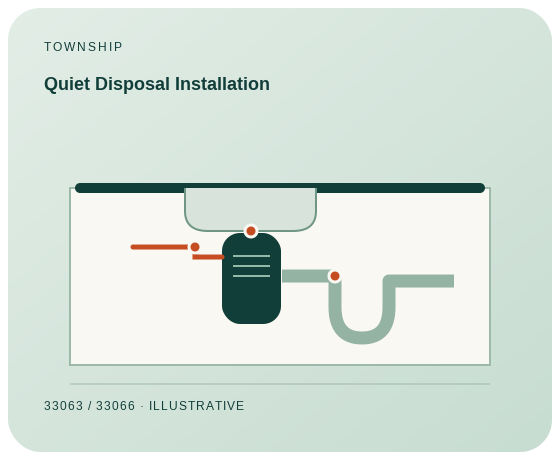
Quiet garbage disposal installation considers both the selected appliance and the way sound and vibration travel through the sink and cabinet. An insulated housing is one part of that comparison. A kitchen in a largely 1980s master-planned development may have been remodeled several times. Treat the current sink depth, cabinet insert and appliance label as the evidence for fit.
A secure compatible mount, suitable waste alignment and separation from adjacent objects also matter. The aim is an informed lower-noise choice for the actual kitchen, without promising silence or inventing a decibel reduction. For this Township project, village identification and the division between kitchen equipment and building-managed drainage shape what information we need before agreeing on the work.
Describe the symptom precisely
Which observations help define the right scope?
For quiet garbage disposal installation in Township, distinguish the following clues from a confirmed diagnosis. The planned correction needs to match the observed condition, not a community-wide assumption.
Noise can come from normal operation, a foreign object, a loose or unsuitable connection, vibration against cabinetry or another fault. Those situations are not all solved by buying a quieter model. A kitchen in a largely 1980s master-planned development may have been remodeled several times. Treat the current sink depth, cabinet insert and appliance label as the evidence for fit.
- A comfort upgrade is the goal: separate that preference from a sudden noise that needs fault diagnosis.
- Objects touch the enclosure: cabinet contact can be part of the sound assessment.
- The mount moves or rattles: support condition deserves attention before a model change is assumed to solve it.
- A deeper sink limits room: a larger sound-treated housing still needs a workable waste connection.
A newly harsh scraping sound deserves diagnosis, while a household preference for reduced operating sound is a different project. Describe what changed, when the sound occurs and whether the appliance otherwise drains and operates normally. The same community label should not cause an installer to assume either a shared pipe or complete owner responsibility.
Follow the actual connections
How should the method fit this home?
We check the existing sound complaint and the selected unit’s dimensions and documented features. It evaluates the sink support, mounting condition and whether pipework or stored objects contact the appliance. The development period does not date the disposal now fitted beneath a particular bowl.
A larger sound-treated housing may change cabinet clearance and discharge alignment. Mechanical fit and connection quality must therefore be confirmed before an insulation claim is treated as a complete installation plan. For a condominium or attached unit, establish who can approve changes and who investigates any common drainage. For a detached address, describe that different setting to us.
Safe preparation and access
What should be ready before the visit?
Record the model and describe the type of sound without repeatedly operating a unit that may be jammed or damaged. Photograph visible cabinet clearance and note objects resting against the housing or pipes. Use the actual village name as well as Township when arranging arrival. The master association and individual village or building management are different contacts.
Ask to compare the new unit’s physical dimensions and written product features. Do not pack improvised insulation around the motor, obstruct required access or tighten mounting parts without knowing the correct assembly procedure. Ask the relevant party about present contractor access rather than assuming a single gate procedure covers the entire master plan.
Define the authorized work
What should we explain step by step?
We should distinguish a fault that needs repair from a sound-comfort upgrade. Confirm the selected model, mounting compatibility, cabinet clearance and electrical scope before work. For Township, ask: Which village or building contact must authorize work beyond this kitchen?
During assembly, connected parts should not be forced into alignment or left transmitting avoidable contact against the cabinet. At handover, ask for normal operation to be demonstrated and for any remaining sound characteristic to be explained without unsupported numerical promises. Record the village and unit on the service paperwork and ask for the actual sink and dishwasher routes to be tested.
Compare a complete proposal
What affects the cost and approval scope here?
Appliance features, housing size, mounting condition, sink support and necessary connection changes affect the installed cost. Ask what evidence supports a product’s sound-treatment claims and whether the comparison uses the same operating conditions. For a condominium or attached unit, establish who can approve changes and who investigates any common drainage. For a detached address, describe that different setting to us. Relate those responsibilities to the specific quiet garbage disposal installation proposal rather than treating every kitchen task as identical.
| Community / city | Township, Coconut Creek, FL |
|---|---|
| County | Broward County |
| ZIP context | 33063 / 33066; confirm the particular address |
| Water service | City of Coconut Creek retail water service; Broward County bulk supply. Confirm account/building meter. |
| Plumbing permits | City of Coconut Creek Building Division; confirm the project scope |
| Housing | Villas, condominiums, townhomes and detached homes in multiple villages. |
| Arrival / authority | TCMA master association plus village/building management; gate arrangements vary. |
A premium unit cannot compensate for every unrelated cabinet contact or damaged mount. Compare the whole installation and written terms rather than a promise of silence or an unverified sound percentage. The development period does not date the disposal now fitted beneath a particular bowl. These are questions for the current Township arrangement, not evidence that the appliances share the community’s construction age.
Verify the original concern
What should you check after the work?
Listen during our normal operating demonstration and ask what was done to the mount and adjacent connections. Accessible joints should also be checked for leakage and drainage, including a connected dishwasher where relevant. If we identify a restriction outside our agreed kitchen scope, obtain a clear account of the finding to pass to the responsible manager.
Keep the model literature so future comparisons refer to actual equipment features. If a new impact or scraping sound appears, report it as a possible fault rather than assuming it is part of the quietness tradeoff. A kitchen in a largely 1980s master-planned development may have been remodeled several times. Treat the current sink depth, cabinet insert and appliance label as the evidence for fit. Keep that distinction in the Township service record so the installed model and observed condition remain clear.
Address an active hazard
When should you stop and seek help?
A suddenly loud unit with metal impact, a stalled hum, smoke, burning odor or leakage should be switched off and assessed. A sound-comfort comparison can wait until an active fault is made safe. For a condominium or attached unit, establish who can approve changes and who investigates any common drainage. For a detached address, describe that different setting to us.
Do not keep operating a suspicious mechanism to make a recording, and do not place hands or improvised sound-damping materials inside the equipment. Keep clear of electrical parts when water is present. Record the village and unit on the service paperwork and ask for the actual sink and dishwasher routes to be tested.
Four local answers
What questions apply to this community and service?
For quiet garbage disposal installation in Township, use these questions with our project-specific assessment.
What does Township preparation mean for this service?
Use the actual village name as well as Township when arranging arrival. The master association and individual village or building management are different contacts. For quiet garbage disposal installation, record the model and describe the type of sound without repeatedly operating a unit that may be jammed or damaged. Photograph visible cabinet clearance and note objects resting against the housing or pipes.
What should we assess inside this Township kitchen?
We check the existing sound complaint and the selected unit’s dimensions and documented features. It evaluates the sink support, mounting condition and whether pipework or stored objects contact the appliance. In this community, a kitchen in a largely 1980s master-planned development may have been remodeled several times. Treat the current sink depth, cabinet insert and appliance label as the evidence for fit.
Who confirms the scope of quiet garbage disposal installation in Township?
For a condominium or attached unit, establish who can approve changes and who investigates any common drainage. Appliance features, housing size, mounting condition, sink support and necessary connection changes affect the installed cost. Ask what evidence supports a product’s sound-treatment claims and whether the comparison uses the same operating conditions. For this Township project, have us confirm municipal requirements separately from the owner or community authorization.
Which completion record matters for Township?
Keep the model literature so future comparisons refer to actual equipment features. If a new impact or scraping sound appears, report it as a possible fault rather than assuming it is part of the quietness tradeoff. For the Township address, if we identify a restriction outside our agreed kitchen scope, obtain a clear account of the finding to pass to the responsible manager.
Keep the decisions connected
Which related guides help compare the next step?
Compare quiet garbage disposal installation across Coconut Creek with Township replacement planning. The first guide explains the technical scope, while the second covers the broader household decision for this community. If the existing appliance has failed, replacement planning beyond quiet garbage disposal installation in Township provides the citywide replacement comparison.
A related scope is batch feed garbage disposal installation in Township; another is garbage disposal flange replacement in Township. A damaged or unsuitable mounting connection can require correction before a lower-noise appliance is fitted. Ask whether the sound complaint points to that fault or to a comfort preference, then compare the appropriate complete scopes. Apply the distinction to a Township resident describing the actual villa or condo kitchen before comparing sound-comfort options rather than authorizing both labels without an explanation.